DownUnder CTF 2023 Writeup
Writeup các challenges từ DownUnder CTF 2023.
apbq II
Challenge
from Crypto.Util.number import getPrime, bytes_to_longfrom random import randint
p = getPrime(1024)q = getPrime(1024)n = p * qe = 0x10001
hints = []for _ in range(3):    a, b = randint(0, 2**312), randint(0, 2**312)    hints.append(a * p + b * q)
FLAG = open('flag.txt', 'rb').read().strip()c = pow(bytes_to_long(FLAG), e, n)print(f'{n = }')print(f'{c = }')print(f'{hints = }')
Analysis: The challenge provides 3 numbers that are linear combinations of p and q along with their product, and asks us to recover p and q in order to break the RSA encryption.
Since there are 3 hints, I’ll label the three equations as:
a1q + b1p == h1 (1)a2q + b2p == h2 (2)a3q + b3p == h3 (3)Eliminating q from equations (1) and (2) gives us , or equivalently
Similarly,
Multiplying these together yields
Following this approach we can build up 9 equations. However, looking back after the event ended, it turns out just 2 hints are actually enough to solve the challenge.
Building a lattice matrix:
Looking at equation (*), we can treat it as a 3-variable equation
This is a linear equation, so we can solve it with LLL using the matrix:
This matrix will contain a short vector holding the solution: (I’ll spare the full derivation).
We also have the identity
From this degree-2 homogeneous equation I can recover the ratio , and since is divisible by , we can compute the gcd to recover p.
Solution
from Crypto.Util.number import long_to_bytes
n = 19604411241131769363446674414275822275458180476470552084588074159518829172495704100505151090666577360738167275118902368371310303168115405693118232835691333564186301532462296609038929723894816307213749698854885742811071911120730847279568876996811433319487396434622751326281226335521193361938724747445445693062336009352580319440819629260614301234971135026395941954109172567154559773437059174108362692061503832044135079892892132874437669744266153424229215832487832220575345912010076934611701182205068942016022731469408259665250938484104489962832891496953003599692437819685070043991828977623632396604764153766442526750861c = 16285668872352205553535195410427806596787838055817589230402081772267074935944610262823936480340920868690431897597533868262062616060037808676539290467732178272289192993251540763800683055555842878669862850848141950704501553807462214356142018528608581546359772903806691435935873069006470208826518183488708349814610769150918356795466688732617809664831695402633481224388822180989614886783145141129157248734213457746877012517003702540070132542733288350979858743766340483503277308585752213220454288897741262154622769402029906981612699288206404870733274360554941455758083078106150045394190625280336371690998959720015636304971hints = [773921762798470573303163880380136299117907456177270598418425239064611119645412840945432294881005107606154919094297188183879147500755682510817840590276985061404198538395146658442221987303866921786284298394947485319583779671756246394491275898343836522004269864718405399287554020900395899143149709408762450693357109188640512875099087677956684946219071353228860650842182953922400081939934842271539450654323, 1506346165967409413422972644306025635334450240732478358292064973873339506571546529986180145578525288707094235933775031106971678278204568310035260899591267480098015553318079460357474533531922997212816264042117005473870580122983241038123126855791876827449194400045937398578284016176289760858365282167537689282643483235235028505475719615108102516557986483184881658418430287064598580231630440534438966422546, 531028473288853560172466570664059891687387973059926255729701774553291285115938502989142318123512885100092638435578692032744904444237266108167428726130739434630511943317357743527053899234918340191006102436386051432760331852295930159729030763033361158582919982579082557775409422474301977588011705535991555292564664521116375190464371518812625647175447427886432255779925378071998411170643507118426289778768]
h1, h2, h3 = hintsm = Matrix.identity(QQ, 4)m[0,0] = 1 / 2^614m[1,1] = 1 / 2^615m[2,2] = 1 / 2^614m[0,3] = h2^2m[1,3] = -h1*h2m[2,3] = h1^2m[3,3] = n
m = m.LLL()
a1b1 = m[0][0] * 2**614
a2b1_a1b2 = m[0][1] * 2**615
a2b2 = m[0][2] * 2**614
R.<t> = PolynomialRing(QQ)
f = a1b1*t^2 - a2b1_a1b2 * t + a2b2
t1, t2 = f.roots()[0][0].as_integer_ratio()
p = gcd(h1*t1-h2*t2,n)
q = n // p
d = pow(65537, -1, int(p-1) * int(q-1))
m = pow(c,int(d), n)
print(long_to_bytes(int(m)))
Mini DNS Server
Challenge
import timefrom dnslib.server import DNSServer, BaseResolverfrom dnslib import RR, TXT, QTYPE, RCODE

class Resolver(BaseResolver):    def resolve(self, request, handler):        reply = request.reply()        reply.header.rcode = RCODE.reverse['REFUSED']
        if len(handler.request[0]) > 72:            return reply
        if request.get_q().qtype != QTYPE.TXT:            return reply
        qname = request.get_q().get_qname()        if qname == 'free.flag.for.flag.loving.flag.capturers.downunderctf.com':            FLAG = open('flag.txt', 'r').read().strip()            txt_resp = FLAG        else:            txt_resp = 'NOPE'
        reply.header.rcode = RCODE.reverse['NOERROR']        reply.add_answer(RR(qname, QTYPE.TXT, rdata=TXT(txt_resp)))        return reply

server = DNSServer(Resolver(), port=8053)server.start_thread()while server.isAlive():    time.sleep(1)
The challenge asks us to send a DNS query to the server for the domain free.flag.for.flag.loving.flag.capturers.downunderctf.com, with a request no longer than 72 bytes and a question type of TXT.
I had been reading up on DNS before this challenge, so I was quite interested when I saw it. Unfortunately, I didn’t have enough time to finish during the competition :((
Structure of a DNS Query
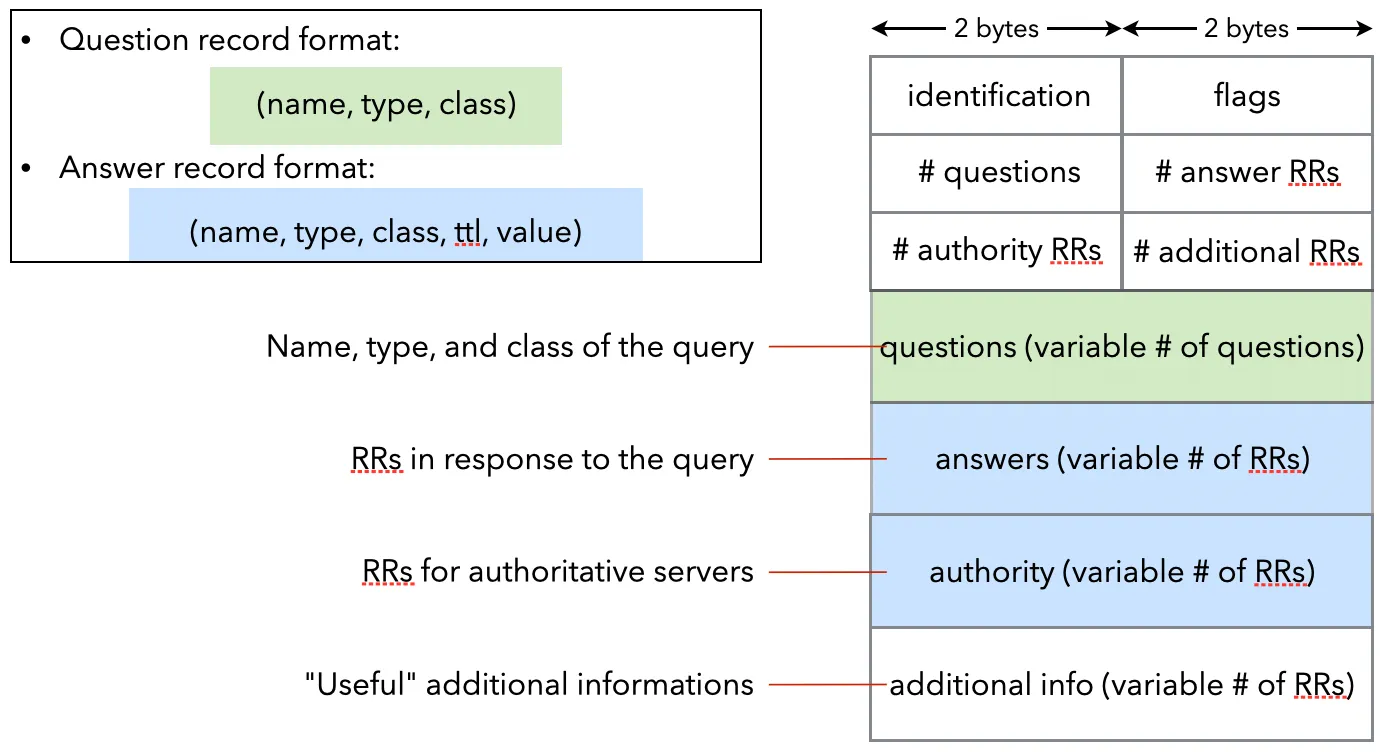
import dns.queryimport dns.messageimport dns.rdatatype
domain = 'free.flag.for.flag.loving.flag.capturers.downunderctf.com'qname = dns.name.from_text(domain)dns.message.make_query(qname, dns.rdatatype.TXT).to_wire()# b'\x13\xec\x01\x00\x00\x01\x00\x00\x00\x00\x00\x00\x04free\x04flag\x03for\x04flag\x06loving\x04flag\tcapturers\x0cdownunderctf\x03com\x00\x00\x10\x00\x01'
As we can see, the first 2 bytes are the ID, the next 2 bytes are flags, then 2 bytes for the question count (which is 1), followed by 6 bytes for answer, authority, and additional counts that we don’t use — that’s 12 bytes of header in total.
Each subdomain label takes the form \x??abcde where \x?? is the length of that subdomain.
For example: blog.anhtv.live is encoded as \x04blog\x05anhtv\x04live
\x00 marks the end of a domain name.
The 2 bytes near the end indicate the QUERYTYPE (\x00\x10 is TXT).
The last 2 bytes indicate the QUERYCLASS (\x00\x01 is IN — Internet).
So as it stands, the query is already 75 bytes long. How do we get it down to 72?
DNS Pointer and Solution
To handle long messages, DNS uses pointers to refer back to previously seen data.
\xc0 + offset moves the DNS pointer to that position in the packet.
Noticing that the server doesn’t check the flag bytes and the first 2 bytes are arbitrary, we can make use of those 4 bytes by placing .com at the very beginning of the packet:
b = b"\x03com"# Reuse the \x00 domain terminator byteb += \x00\x01\x00\x00\x00\x00\x00\x00# Domainb += \x04free\x04flag\x03for\x04flag\x06loving\x04flag\tcapturers\x0cdownunderctf# Pointer back to the start (where .com lives)b += \xc0\x00b += \x00\x10\x00\x01Now we have the complete payload — let’s send it to the server.
import socket
host = "0.0.0.0" # Replace by DNS Serverport = 8053
sock = socket.socket(socket.AF_INET, socket.SOCK_DGRAM)
sock.sendto(b, (host, port))t = sock.recv(4096)print(t)sock.close()
Comments